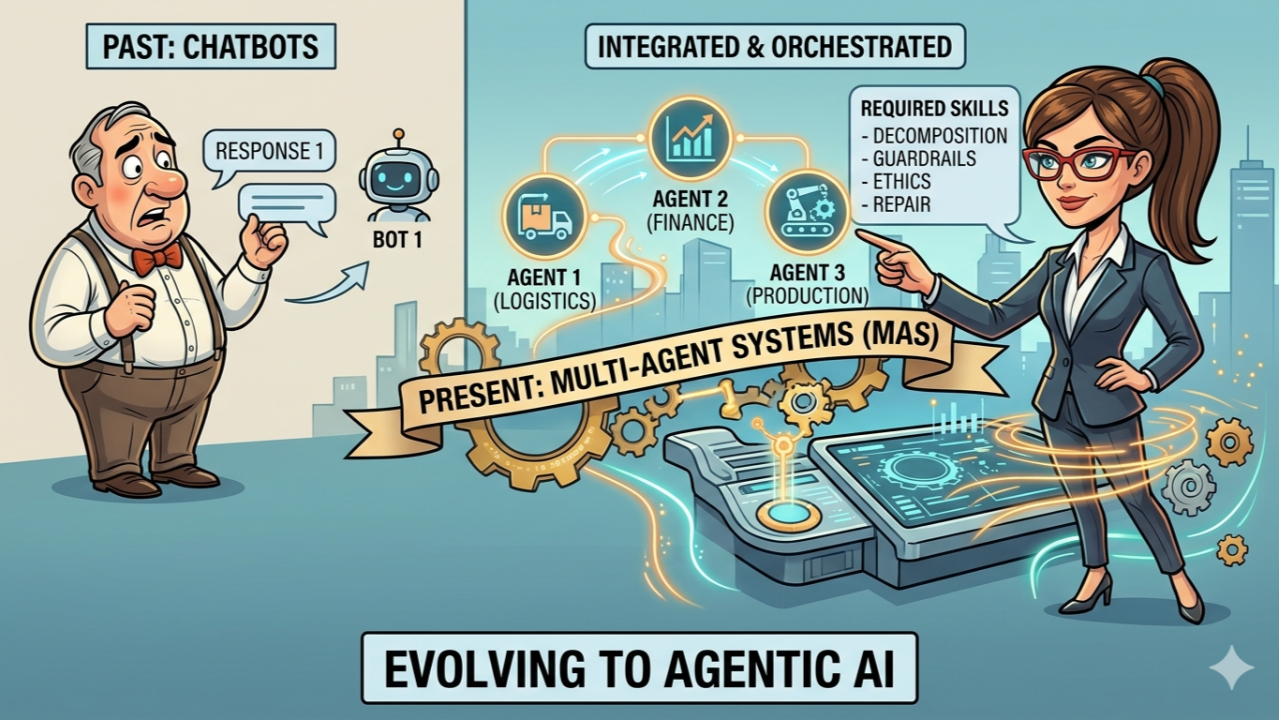
AI is no longer just a digital concierge waiting to answer your questions. We have entered the era of Agentic AI, autonomous entities equipped with specific skill sets and the authority to execute complex tasks that were once the sole domain of humans.
As these agents evolve, they are coalescing into Multi-Agent Systems (MAS). Imagine a digital ecosystem where specialized AI agents talk to one another to manage entire business cycles. While this promises unprecedented efficiency, it also echoes a classic economic theory from 1776: Adam Smith's The Wealth of Nations.
The Digital "Division of Labor"
Adam Smith revolutionized industry by introducing the Division of Labor, arguing that breaking work into specialized tasks creates "muscle memory" and drives productivity. Today, we are seeing this concept reach its zenith.
In modern business, core functions like finance, inventory management, and production are being handed over to AI agents. But as AI reaches the peak of productivity, the human role is not disappearing, it is ascending. We are moving away from manual execution and toward a premium skill set: the System Architect.
The Needs of Premium Skillset "System Architect"
In this new landscape, companies no longer just need operators; they need System Thinkers and Designers. These architects are the conductors of the AI orchestra, and their value lies in four critical pillars.
Decomposition: The ability to break down vague business goals such as "Improve market share in Southeast Asia" into logical, executable sub-tasks for agents.
Constraint Engineering: Defining what agents should not do by setting guardrails, logical boundaries that prevent an agent from, for example, offering a 90% discount just to close a sale.
Algorithmic Ethics: Since agents lack common sense, an Architect must anticipate biases or instances where efficiency might result in social or legal blowback.
Failure Analysis: When a swarm of 50 agents produces a chaotic result, the Architect must debug the organizational logic, not just the code.
The Price of Progress: The Governance Hurdle
Scaling an Agentic AI system is not free. Implementing the necessary IT governance involves significant financial and structural risks that every C-suite executive must weigh.
1. High Initial Capital Expenditure (CapEx)
Consulting fees: Mapping frameworks like COBIT or ISO standards often requires expensive external experts. Software licensing: Enterprise-grade Governance, Risk, and Compliance (GRC) tools involve costly subscriptions. Training costs: Certifying staff leads to direct costs and a temporary loss in productivity.
2. Ongoing Operational Overhead (OpEx)
Headcount growth: The need for dedicated Compliance Officers, Data Protection Officers (DPOs), or Internal Auditors. Audit fees: Mandatory recurring annual payments for third-party audits such as SOC2 or ISO 27001. Documentation labor: The substantial hidden cost of time spent documenting processes rather than building products.
3. The "Over-Engineering" Risk
Framework mismatch: A lean startup implementing complex controls designed for multinational banks results in an unsustainable cost per control. Diminishing returns: Spending more on a security control than the actual value of the risk it reduces leads to negative ROI.
4. Opportunity Costs
Delayed time-to-market: Rigorous governance reviews can delay AI-driven modules, resulting in lost revenue. Resource diversion: Shifting top-tier architects from building to governing can stall the technical roadmap.
5. The "Shadow IT" Financial Leak
Redundant spending: Departments may bypass slow governed channels to buy their own SaaS tools, leading to triple-paying for the same functionality. Contractual risks: Penalties for data breaches in these shadow systems often far exceed the cost of the original governance plan.
The "Black Swan" and the Power of Productive Friction
Perhaps the most fascinating risk is perfection. A perfectly efficient agentic system is inherently dangerous. Because AI lacks human gut feeling, it can accelerate toward a cliff without blinking, potentially creating Black Swan events, unforeseen, high-impact crises.
This is where the human element becomes indispensable. The System Thinker provides productive friction, the intentional human pause. It is the checks and balances that ensure the business is not just running fast, but running in the right direction.
The Bottom Line
The transition to Agentic AI is more than a technical upgrade; it is a fundamental restructuring of human capital, cost structures, and organizational logic. Success in this era will not be defined by who has the fastest AI, but by who has the best Architects to manage the costs, the risks, and the logic behind the machine.
https://www.linkedin.com/pulse/human-agentic-ecosystem-irsam-satya-gana-d7j6c/